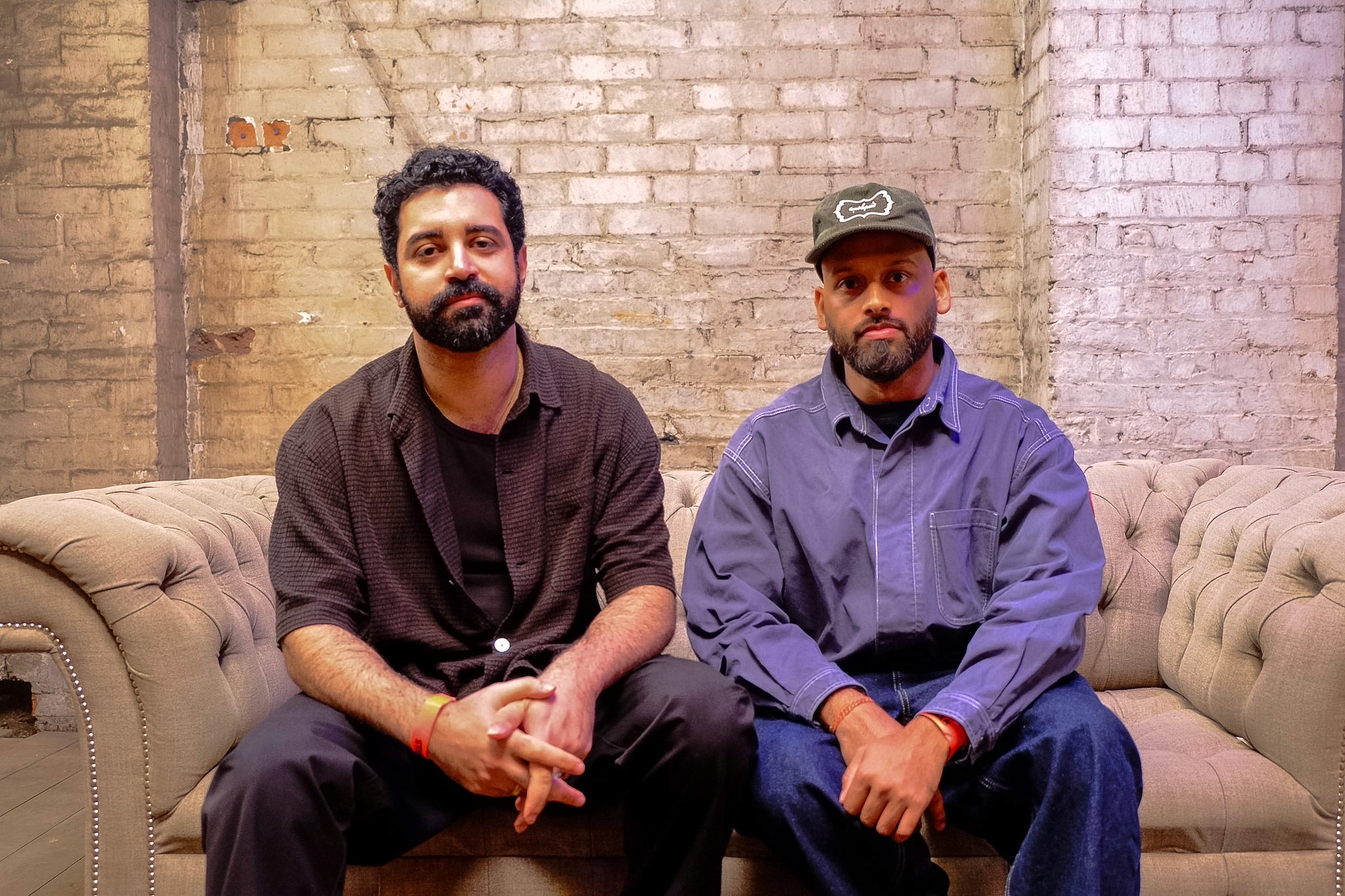
To drop a needle on a Dar Disku record is to step through a transportive tunnel, where the dusty turntables of 1970s Cairo are wired directly into the bass-heavy sound systems of the modern British underground.
That was one of my biggest takeaways after interviewing and witnessing the fantastic duo, Mazen & Vish, during their headline set at the festival, ‘Jam on the Horizon’. Being in Bristol, arguably one of the strongest points of reference for the duo, I first asked them about what drove their close bond to Bristol and how this has affected their sound:
Vish painted the picture for me, saying “Bristol's always been really community-driven; Noods radio helped us meet friends and other like-minded artists, and that collectiveness that Bristol has is quite true to what we do anyway. If anything, it’s just made that sense of community and togetherness in our music a lot stronger.”
Mazen then recounted their recent live album and the recording that took place at Humm Studios in Bristol. It was here that the self-titled album ‘Dar Disku’ was created, with hits such as ‘Sabir’, ‘Alsutur’, and my personal favourite ‘Baar Baar’.
When you strip away the club lights, what is Dar Disku at its absolute core? I asked Mazen and Vish to recount the precise tipping point, the memory where the distance between generations collapsed, and they witnessed the music of their elders being fiercely embraced by the crowds of today.
Vish was quick to share his thoughts saying “Some of the nights we’ve done at the Jazz Cafe have been really special I felt that sense of like, Oh my god, there's people from all walks of life here. There are people from Bahrain, there are people from the Middle East, there are people from India, from all over the world. Just seeing people who look like you in a crowd, dancing to the music that you’ve had a say in or are playing, is really special. Obviously Glastonbury was a bit of a milestone for us”.
Mazen then spoke about how it’s in these moments that “you can push the envelope a little bit, where you can experiment a little bit more”, and how that then goes on to fuel the productions we see today. As DJs, I asked them to help me understand how you get past the fear of dropping a track, get past the “Is this too much?” For context, in high-stakes situations, one track can make the difference between a moving crowd and a stationary one. Vish reassured all of us all by stating that “You just trust your gut, then it doesn't become a fear. It becomes intuition, it becomes natural. Then when it does work out, you realise that trusting your gut as a DJ or a selector is the most important thing. If you force something or likewise on the other hand, prevent yourself from playing what your heart wants to play, you’re stuck in this limbo of not being authentic to yourself, not being authentic to the crowd because they’ve come to see you. They don’t want to see you pretend to be another DJ, they want to see you be you”.
One thing that struck me while talking to the duo was how grounded they were. I could feel those moments as if I was there; it felt like I was actually on the ground in the Jazz Cafe or at Glastonbury with them, behind the booth deciding on what was coming next.
I steered the conversation toward the horizon, asking where Dar Disku is heading next. For the duo the future looks exactly like their foundation, deliberately unbalanced.
“What sits at the core of everything we do,” Mazen explains, “is this desire to create something that feels familiar and accessible, but simultaneously like nothing you’ve ever heard before. And to make that happen, you have to push into the weird territory.”
Intrigued by the horizon, I ask him plainly: “Is it going to get weirder?”
Mazen doesn't miss a beat. “It’s always going to get weirder.”
Our conversation naturally shifted from their own music to the wider architecture of modern club music: edit culture and the ethics of sampling. How does an artist breathe new life into a classic record while genuinely honouring its roots? Vish didn't hesitate, mapping out the fine line between true homage and creative stagnation.
“I have no issue with people doing edits of the same song,” Vish says firmly. “Everyone is going to bring something authentic and unique to it; otherwise, we are just policing creativity and artistry. The real issue comes when you see an edit of the exact same track, using the exact same sounds, trying to replicate someone else’s vibe. At that point, you’re just making an edit of an edit.”
I asked the duo who we should be watching right now. Names fly across the room ; Moktar, Yazaan, Toumba, DJ Plead & Cheb Mimo, the vanguards of a brilliant shifting scene. Yet, it’s the Moroccan selector Retro Cassetta who truly captures their imagination. They vividly recount watching him command a stage at Glastonbury, a blur of motion as he juggled three different cassette tapes while flipping lit cigarettes into his mouth mid-mix.
“Authenticity in its purest form,” Mazen reflects. It’s an inspiring testament to the broader lesson underpinning their entire philosophy: don't compromise, do it yourself, and build a creative world so uniquely your own that nobody else can even stand in the frame.
Then came my favourite chapter of our conversation, an insight that has fundamentally altered how I look at my own creative process. We were parsing through the tireless labour of digging, the endless hunt for samples to flip and tracks to reinvent. That’s when they dropped a piece of wisdom I had never even considered in which they said “look to the front seat of your next taxi”.
“A lot of cab drivers, you forget, are just like us,” Vish reflects. “They are people who moved countries to seek a better life, but there is always that deep, unyielding attachment to home. They are listening to the exact records they grew up with. They are literally doing Dar Disku, but in a car.”
It’s a philosophy born of active observation. They trace it back to a transformative road trip through India while playing at the Magnetic Fields festival in Rajasthan. Taxis became moving sanctuaries, soundtracked by some of the most raw, undiscovered Rajasthani folk music imaginable, an experience they describe in a single word: “hypnotic”.
My takeaway from this segment was this: the finest curation happens when nobody is performing for an audience. It happens in the quiet, honest moments when people play the music they need to hear to feel closer to who they are. If you want your music to have soul, look for the sounds people use to survive, not just the ones they use to party.
If there is a thread that stitches all of this together, from the community airwaves of Noods Radio to a hypnotic taxi ride through Rajasthan, it is that Dar Disku isn’t just a group of projects. It’s a living, breathing proof of concept. They are reminding us that the music of our elders doesn't belong in a museum; it belongs in the middle of a sweaty warehouse, colliding with the future.
As I stepped away from our conversation and watched them command the stage at Jam on the Horizon, Mazen's final words echoed in the back of my mind. The blueprint has been thrown out. The copies of copies have been discarded. The future of global dance music isn’t safe, isn't polished, and isn't looking for permission. It’s sitting in the front seat of a cab, it's spinning on three tape decks at Glastonbury, and it’s fueling a crowded Bristol dancefloor.
Buckle up. It’s always going to get weirder.
Written by Prithvi
Share
Copy link
